
Zinc Selenide, ZnSe Sight Windows for CO2 Laser
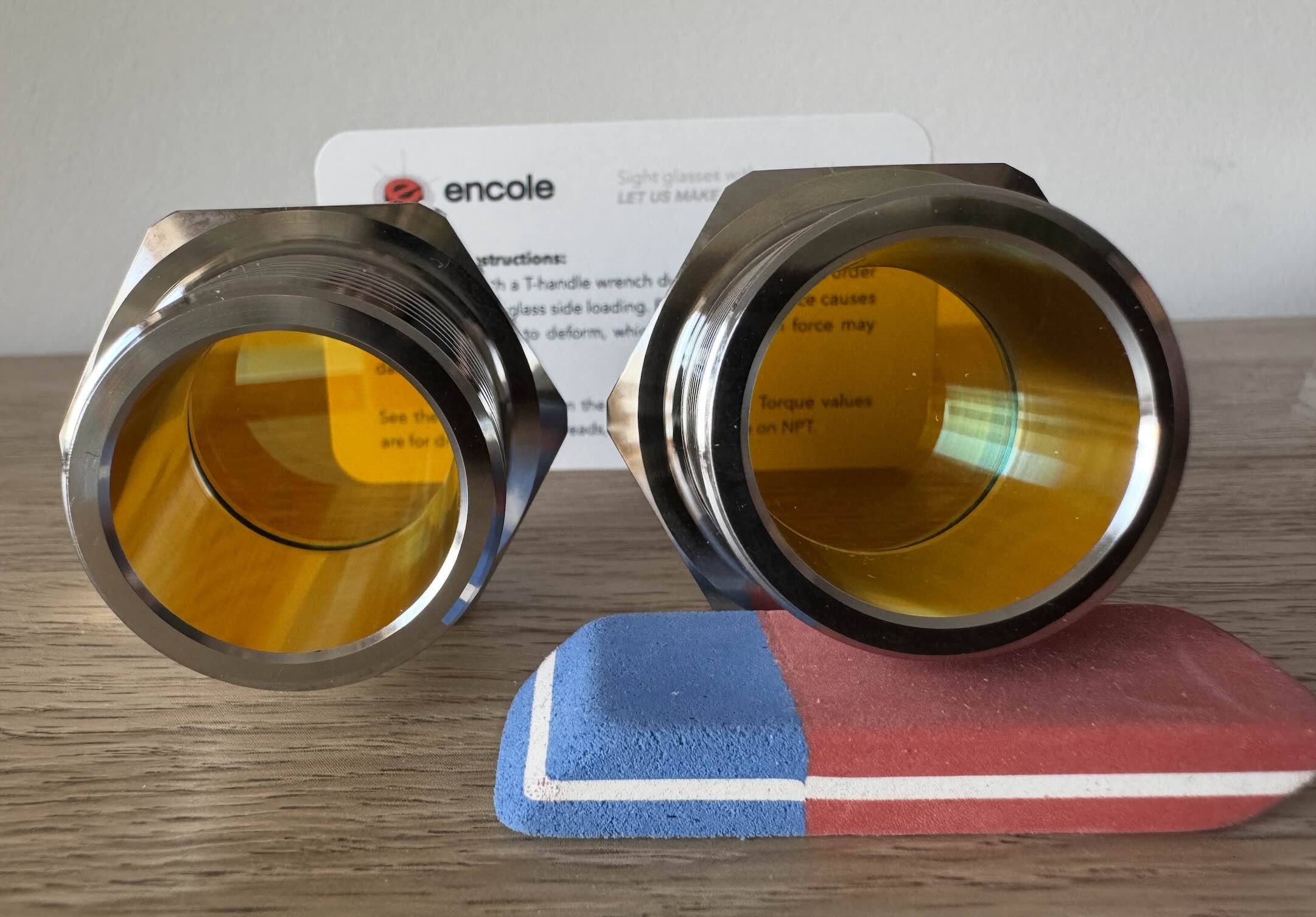
View through ZnSe NPT sight glasses, from the process side. Notice the windows are transparent in the visible range. These are raw ZnSe, uncoated windows with about 17% surface reflection loss per face.
In this design, a Zinc Selenide (ZnSe) window is mechanically mounted within a NPT-1" metal fitting to form a pressure-retaining optical viewport. The optical element is internally sealed using an elastomer O-ring that provides both pressure containment and vibration isolation between the brittle crystalline window and the metal housing. This elastomer seal also accommodates thermal expansion mismatch between the ZnSe window and the surrounding metal body.
ZnSe is a polycrystalline infrared optical material with excellent transmission in the mid-infrared spectrum, typically from approximately 0.6 µm to 16 µm, with peak transmission in the 8–12 µm region. Because of this wide IR transparency and low absorption at 10.6 µm, ZnSe is commonly used in optical components for carbon dioxide laser systems. The material also has a relatively high refractive index (~2.4 at 10.6 µm) and good optical homogeneity, which allows it to be used for both resonator windows (maximum transmission) and focusing optics in infrared instrumentation.
From a mechanical standpoint, ZnSe has a rupture modulus typically in the range of 55–70 MPa, depending on surface finish and crystal quality. This strength is comparable to common pressure-window materials such as tempered borosilicate glass or fused quartz. When properly supported by a metal retainer, ZnSe windows can therefore operate in moderately high pressure environments such as pressurized process lines, optical monitoring ports, or laser processing chambers.
The primary limitation of ZnSe in industrial environments is its temperature sensitivity and chemical stability at elevated temperatures. At ambient pressure the material begins to oxidize in air above approximately 300 °C, which can degrade surface quality and optical transmission. Above roughly 500 °C the material softens and mechanical strength decreases significantly. For this reason ZnSe windows are generally not recommended for continuous industrial operation above about 200 °C, particularly in oxidizing environments.

Part Number 102354-ZN
In the present sight glass design, the maximum operating
temperature is limited by the internal sealing element rather
than the window itself. The assembly uses an Aflas® fluoroelastomer
O-ring, which provides good resistance to supercritical CO2, heat, steam, and many
aggressive chemicals. However, elastomer seals gradually lose hardness
and mechanical strength as temperature increases.
For this assembly the design pressure rating is 3200 psi (~220 bar)
at 150 °C. Above this temperature the Aflas O-ring begins to soften,
which reduces the sealing force and increases the risk of extrusion or
leakage under pressure. As a result, the allowable pressure rating of
the ZnSe sight glasses decreases with increasing temperature beyond this point.
Contact Encole for design and manufacture of ZnSe sight glasses.