"ZnSe NPT threaded sight windows for high pressure applications. Market analysis and outlook."
Zinc Selenide is an optical material transmitting from 0.5 to 21 micron, well suited for devices operating in the infrared range. This article focuses on the general market for ZnSe optical windows and high pressure ZnSe sight glasses in particular. Majority of demand for infrared optics is in CO2 laser applications. Total ZnSe consumption in 2025 is estimated between USD $400-500M. There is no single report cleanly isolating market data for ZnSe optical components (all use cases). Here is the aggregated summary table. This is manufacturer’s data from what we could find:
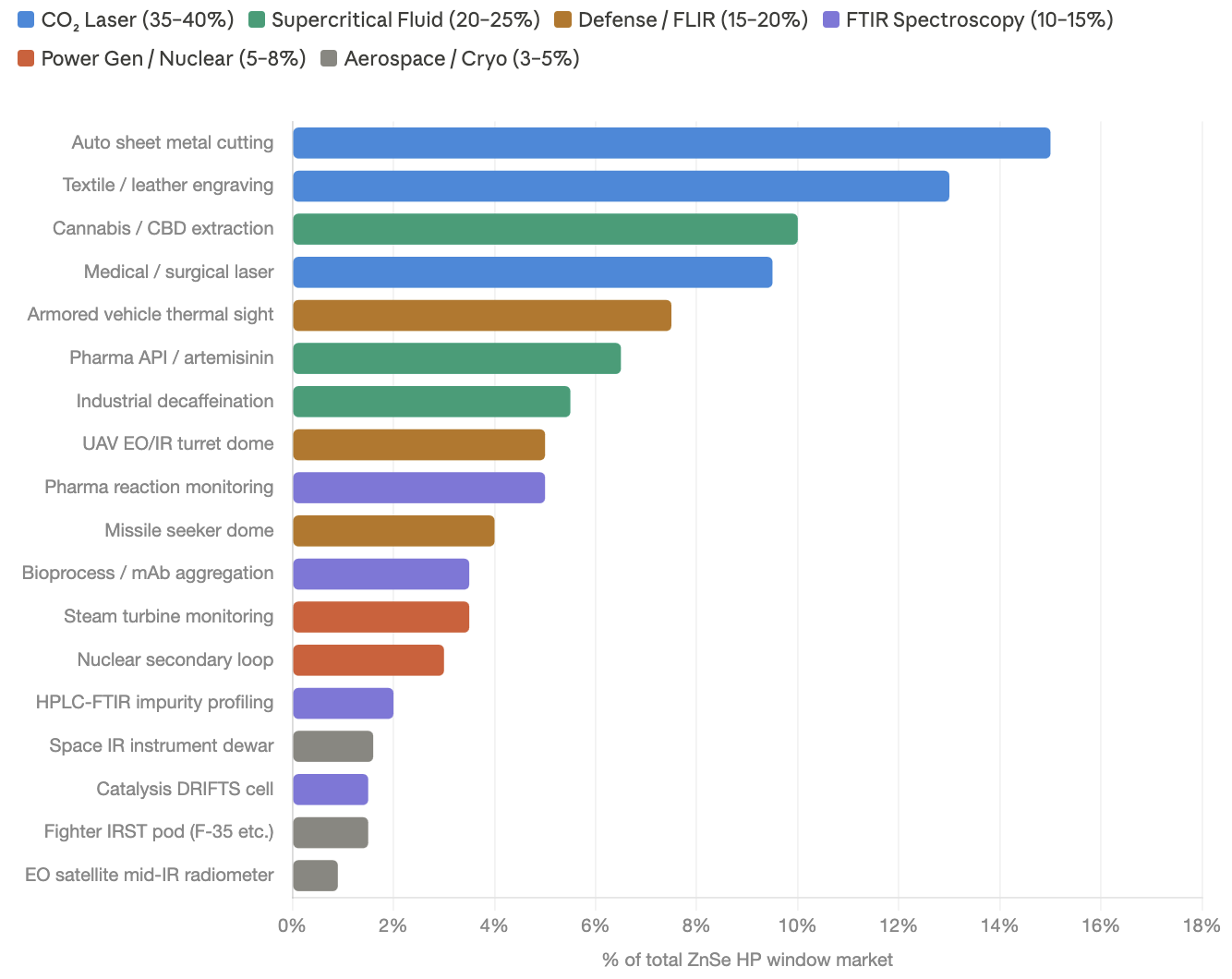
The global CO₂ laser market was valued at USD 3.2 billion and is estimated to grow to reach USD 5.5 billion by 2034. ZnSe windows are a consumable component in every sealed CO₂ laser resonator. The window replacement and OEM supply market within CO₂ laser systems is estimated at $150–$250M globally, representing the single largest share of ZnSe high pressure sight glass demand at roughly 35 - 40% of the total ZnSe pressure window market.
Over 35% of automotive manufacturers utilize CO₂ lasers in the 500W–1kW range for precision cutting of metal components. Automotive manufacturing consumes estimated ~$60–$80M in annual ZnSe windows globally. The industrial processing segment accounts for USD $1.5 billion in 2025. CO₂ lasers in industrial processing are used for cutting, welding, engraving and marking, with applications extending to non-metallic materials including plastics, textiles, wood, glass, and paper - fundamental in automotive, electronics, and packaging industries.
In automotive body panel fabrication lines operated by companies like Trumpf, Mazak, and Prima Power, CO₂ lasers in the 2-6 kW range cut aluminum and high-strength steel blanks at speeds of ~100 inches/min. The sealed resonator contains a CO₂/N₂/He mixture at 2-5 bar, and the ZnSe output window (typically 28-38 mm diameter, 5-8 mm thick) is the pressure seal between this gas cavity and the ambient.
Nearly 30% of textile cutting rely on CO₂ lasers. Not a player for high pressure ZnSe optics. ZnSe windows in CO₂ lasers used by apparel manufacturers for cutting synthetic fabric, leather, and technical textiles (e.g., Epilog Laser, Universal Laser Systems) operate at much lower power (30-150 W) and near-atmospheric pressures, but still serve as protective barriers between the resonator gas and contaminants from the cutting process.
The healthcare segment in the CO₂ laser market is a non-player in high pressure ZnSe.
The supercritical CO₂ extractor market was valued at USD 1.5 billion in 2025 and is projected to reach USD $3.0 billion by 2032. Within this, ZnSe optical windows and sight glasses represent the critical in-situ monitoring component estimated at $8–$18M or roughly 20–25% of the total ZnSe high-pressure window market.

Over 1,800 extractors were deployed globally in the hemp and cannabis segment for the production of pure CBD oil as of 2024. ZnSe is the window of choice in pharmaceutical-grade operations, capturing an estimated 55–65% of the in-situ spectroscopy window market in this sub-segment. The pharmaceutical industry represented a 40% share in 2023 among supercritical CO₂ extraction equipment installations. The U.S. cannabis sector accounted for nearly USD $23.4 million in extraction equipment placed in 2024, with cannabinoid extraction being a major use case.
ZnSe windows on extraction vessels operating at 250–320 bar serve as in-situ FTIR monitoring ports. The windows are seated in a housing-nut assemblies with an o-ring capable of withstanding both the supercritical CO₂ and exposure to the extracts.
This is for malaria treatment. A pharmaceutical manufacturer in Europe using 50-liter supercritical CO₂ extractors with ZnSe windows integrated into extraction vessels for in-situ monitoring. This seems to be a player in ZnSe optics, however, the market share is inconclusive.
One of the earliest and largest industrial applications of supercritical CO₂ is decaffeination, used commercially by companies including Kraft and Nestle since the 1980s. ZnSe sight glass windows on industrial-scale extraction vessels (up to 1,000-liter capacity). The food and fragrance industry dominated the supercritical CO₂ extraction equipment market in 2024, accounting for 40.08% of total market revenue driven by increasing demand for natural flavors and fragrances extracted using supercritical CO₂ technology (L.J. Star).
The military thermal imaging market was valued at USD $5.4 billion in 2024 and is expected to grow at a CAGR of 8.6% over 2025–2030 (Stanford Advanced Materials). ZnSe IR windows represent a component-level sub-market within this estimated at $12–$20M globally within the ZnSe high-pressure window segment.
Not sure about this use case going forward. Arial warfare seems to dominate anything on the ground.
In UAV turret systems ZnSe or ZnS dome windows at the front of the gimbal ball are deigned as a meniscus, typically 80-120 mm in diameter. This geometry is chosen specifically because it maintains uniform wall thickness under external aerodynamic pressure loads at flight altitudes and speeds. The rapid expansion of military and commercial UAV fleets is creating one of the fastest-growing sub-segments for ZnSe dome windows, with the global military UAV thermal payload market growing at an estimated CAGR of 9–12% through 2030. Non-player for high pressure ZnSe optics.
Infrared-guided missiles use a forward seeker dome that must simultaneously transmit MWIR radiation for target acquisition, survive aerodynamic heating at Mach 2+ velocities, and structurally withstand the flight dynamic pressure.
Military and defense applications in thermal imaging are projected to grow from USD 1.5 billion to USD #3.1 billion by 2035 (UQG Optics). Missile seeker dome production is the highest-unit-value ZnSe defense window application. Individual seeker domes are priced in the range of $5,000–$25,000 depending on coating, geometry, and qualification level. Production volumes are controlled by classified procurement programs, but the U.S., France, Israel, and the UK collectively account for the majority of IR-guided missile production.
The FTIR market surpassed a revenue of USD 1.7B in 2025, projected to reach approximately USD $2.2B by 2031. Pharmaceutical applications contribute nearly 35% of total FTIR spectrometer demand worldwide. (ARCHON)
ZnSe transmission cells and flow cells constitute the primary window consumable in this market - estimated at $8–$15M globally, or roughly 10-15% of the ZnSe high-pressure window segment.
Commercially available high-pressure ZnSe liquid cells rated for 138–345 bar, with fixed wavelengths of 0.5–10 mm, are installed directly in FTIR benchtop spectrometers.
North America and Europe jointly account for approximately 75% of this high-pressure pharmaceutical spectroscopy cell market, with Thermo Fisher Scientific, Specac, and PerkinElmer as the primary OEMs supplying ZnSe cell assemblies.
ZnSe FTIR flow cells. The pharmaceutical and biotech segment accounted for approximately 45% of total infrared spectroscopy applications in 2024. ZnSe ATR elements and flow cells used in bioprocess monitoring are a rapidly growing niche, expanding at ~8–10% annually as continuous bioprocessing adoption grows in monoclonal antibody manufacturing (Eng-Tips).
A ZnSe disc are used. Additional research is required here.
In-situ FTIR/DRIFTS reaction cells with ZnSe windows allow to study powders under actual reaction conditions: temperatures up to 600°C and pressures up to 34 bar without quenching the reaction for offline analysis. Note, ZnSe windows will oxidize above 300C in air. High temperature spectroscopy requires active cooling of ZnSe windows.
Industrial and chemical applications contributed about 25% of total IR spectroscopy market share in 2024, with roughly 1,500 new instruments installed across petrochemical and polymer processing plants in 2024. Demand for process-ready ATR and gas cell modules increased by 18% (Eng-Tips). Academic and industrial catalysis research cells constitute a small but high-value niche. Individual DRIFTS cell assemblies with ZnSe windows from Harrick Scientific or Pike Technologies retail in the $3,000-$8,000 range.
The global industrial process sight glass market for power generation applications is embedded within the broader industrial sensing and monitoring sector. ZnSe windows in this application represent a very small share, estimated at $3–$8M globally, or roughly 5–8% of total ZnSe high-pressure window demand, but command premium per-unit pricing given nuclear-grade material certifications and ASME pressure vessel code compliance requirements.
In steam power plants, ZnSe windows mounted on the steam line allow a near-IR absorption measurement to discriminate between dry steam and droplet-laden wet steam. Wet steam produces distinctive scattering signatures in the 3-5 µm band that dry steam does not. This information is used to tune steam reheat for the last stage turbine (Encole Engineering).
Global installed capacity of supercritical steam power plants exceeds 500 GW, with over 1,000 generating units worldwide. The retrofitting of in-situ IR monitoring ports to existing units and specification into new-build plant designs represents an ongoing but modest hardware procurement volume, with ZnSe windows for this application purchased in quantities of hundreds per year rather than thousands. (Encole Editorial)
In nuclear power plants secondary loop is the water that changes to steam from the energy in the first loop (first loop flows through the active reactor zone). ZnSe windows in process monitoring ports allow dissolved oxygen and pH indicator measurements, critical for corrosion control in carbon steel secondary loop piping.
The global fleet of operating PWRs comprises approximately 300 reactors across 30 countries. Each reactor may have several optical monitoring ports in the secondary loop, representing a stable but slow-turnover installed base. Nuclear-grade ZnSe windows command a significant price premium (3–5x standard commercial pricing) due to material traceability documentation, radiation-resistance qualification, and ASME N-stamp code compliance requirements, making revenue disproportionately high relative to unit volume. Non-player for new entrant into the market.
The global space sensors market size is projected to grow from USD $6.0B in 2026 to USD $14.4B by 2034. The global satellite earth observation market was valued at USD $9.41 billion in 2024, expected to grow to USD $17.20 billion by 2033.
ZnSe cryogenic and aerospace windows represent an estimated $3-$6M globally, roughly 3-5% of the ZnSe high-pressure window segment, but with the highest per-unit values of any application category.
ZnSe windows on mid-IR instrument aboard scientific and Earth observation satellites serve as boundaries between the ambient orbital thermal environment and cryogenic detector cavities. They must transmit IR wavelengths of interest, withstand the pressure differential during ground testing, and survive launch vibration loads. Space-qualified ZnSe IR windows are produced in extremely small volumes (10-100 units annually) but command extraordinary per-unit pricing. A fully qualified space-grade ZnSe window for a cryogenic instrument can cost $20,000-$100,000+ depending on size, coating, and heritage documentation. These are up there on par in terms of pricing and qualifications with Nuclear ZnSe optics.
The satellite-based earth observation market was valued at USD $3.7 billion in 2024, the defense and intelligence segment was the largest at USD $1.3B, driven by rising investments in real-time, high-resolution Earth Online data to support border surveillance and military reconnaissance.
Long-range IRST systems on fighter aircraft. The ZnSe dome or faceted window cycles from −60°C at cruise altitude to +90°C on the ground apron on every mission. The U.S. F-35 program alone with a planned production run exceeding 3,000 aircraft across multiple nations provides a long-duration demand signal for ZnSe EOTS window assemblies over the next 15–20 years. This is a non-player for high pressure ZnSe optics.
ZnSe windows on mid-IR radiometer cryogenic dewar aboard weather satellites transmit the 8-12 µm band used for sea surface temperature and cloud-top temperature mapping. Weather satellite constellation programs, including NOAA's GOES-R series, ESA's Meteosat Third Generation, and ISRO's EOS series, each require multiple ZnSe cryogenic window assemblies per satellite, with replacement and reflight cycles driving recurring demand every 7-12 years per satellite. Estimating ZnSe demand at approximately $6 million annually for weather satellites. Non-player for high pressure ZnSe optics.
The global remote sensing satellite market is estimated to grow from USD $19 billion in 2026 to $42B in 2034. (Fortune Business Insights) In another source, this market will grow from $41.4B in 2026 to $141.1B in 2034 (Global Market Insights). Notice the data is conflicting, but the market is staggering. We tend to put the market growth at a median point for this segment. Specifically within the remote sensing satellite market, the global infrared sensors market was valued at USD $1.1B in 2024, expected to grow to USD $2.2 billion by 2034, with climate and environmental monitoring missions being a significant growth driver.