"Review of what's practical for ultraviolet windows, and what is niche and what is emerging."
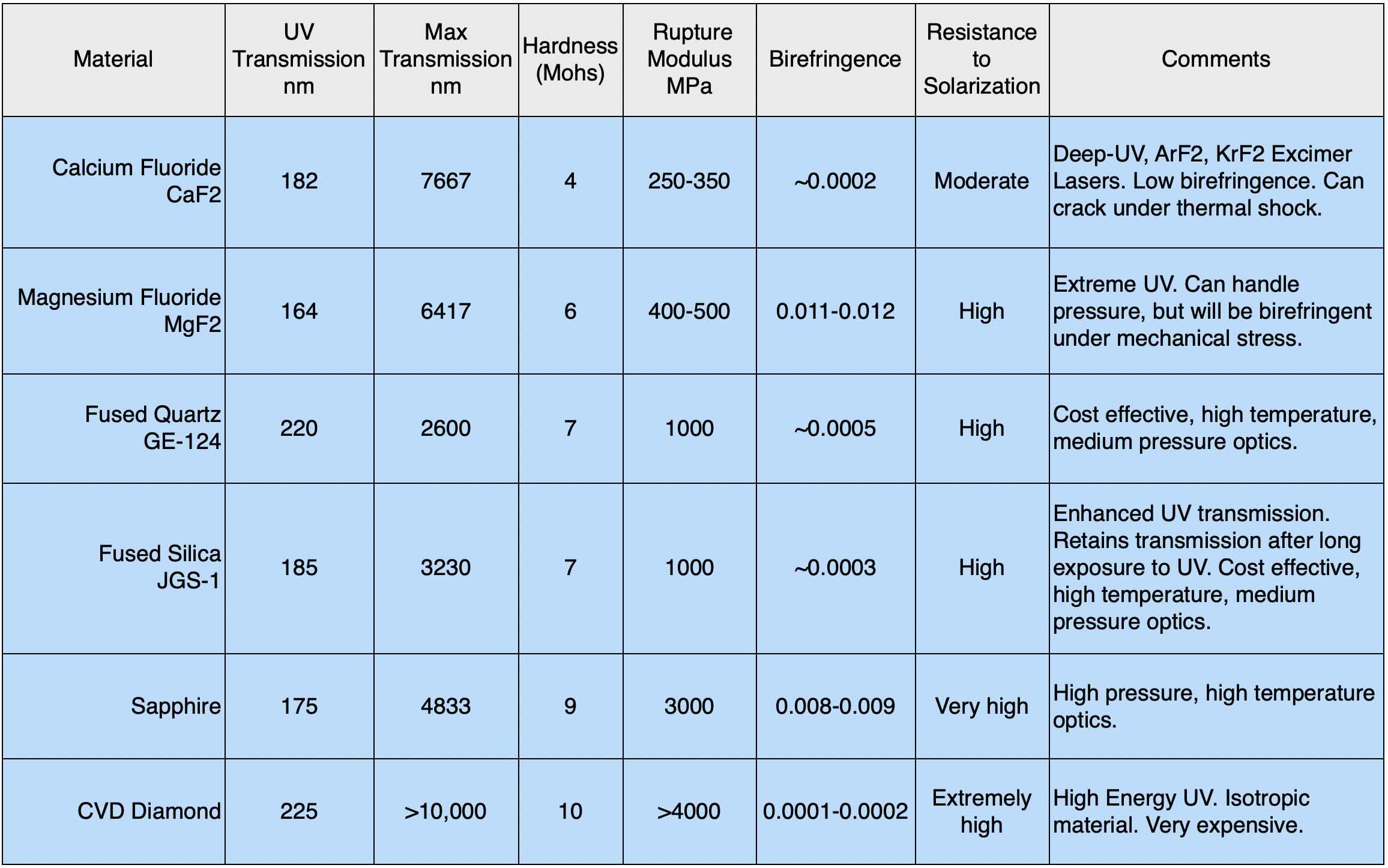
Ultraviolet (UV) optical transmission materials are used in systems that must carry light at wavelengths shorter than visible light. These systems include spectroscopy instruments, excimer lasers, semiconductor lithography tools, space telescopes, and industrial UV curing equipment. Because ultraviolet light spans a wide range: from near UV (around 400 nm) down into the vacuum UV and extreme UV regions, the choice of material depends strongly on wavelength, durability requirements and cost.
A useful way to understand these materials is to separate them into practical, widely used materials and niche, specialized materials.
Practical materials are those that are commercially mature, widely available, and routinely used in industrial systems.
Fused silica (often called UV grade quartz) is the most common UV optical material. It transmits well down to about 180-190 nm, making it suitable for near UV and much of the deep UV range. It combines good optical homogeneity, low thermal expansion, and strong resistance to laser damage. It is also relatively affordable and can be manufactured in large, high quality pieces. For most near UV and many deep UV applications, fused silica is the default choice.
Calcium fluoride (CaF2) becomes important at shorter wavelengths. It transmits down to roughly 150-160 nm and plays a central role in 193 nm semiconductor lithography. Compared to many other crystals, it has low birefringence and good optical clarity when grown properly. Although more brittle and expensive than fused silica, it is well established in precision deep UV imaging systems.
Magnesium fluoride (MgF2) extends transmission even further, down to about 140-150 nm in the vacuum UV. It is durable and environmentally stable compared to many other fluoride crystals. In addition to being used as a bulk window material, it is also widely applied as a thin film anti-reflection coating for UV optics. For many vacuum UV systems, MgF2 is the most practical solution.
Sapphire (single-crystal aluminum oxide) is not the best material for the shortest UV wavelengths, with a cutoff typically around 150–170 nm. However, it is extremely hard, mechanically strong, and resistant to chemical attack. For high-pressure, high-temperature, or abrasive environments where durability matters more than maximum UV transmission, sapphire is an optimum choice.
Together, fused silica, calcium fluoride, magnesium fluoride, and sapphire account for the majority of industrial UV transmission optics.
Some materials are used only when specific wavelength transmission or unusual properties are required.
Lithium fluoride (LiF) transmits down to roughly 105 nm, making it valuable for very deep vacuum UV applications. However, it is soft, mechanically fragile, and sensitive to moisture. These handling challenges limit its use mainly to research instruments and specialized space systems rather than high volume industrial optics.
Barium fluoride (BaF2) offers broad transmission from the ultraviolet into the infrared. Despite this wide spectral range, it is mechanically weaker and more moisture sensitive than many alternatives. As a result, it is typically used in specialized spectroscopy setups or detector systems rather than mainstream precision optics.
Below about 100 nm, in the extreme ultraviolet (EUV) region, transmission optics are rarely practical because nearly all solid materials absorb strongly. Instead of lenses or windows, multilayer reflective mirrors are used in advanced semiconductor lithography systems.
In most real world systems, the dividing line between "practical" and "niche" is not just about wavelength. It is about how easy the material is to grow, polish, coat, handle, and protect in large scale production.
For near UV and much of the deep UV range, fused silica remains the workhorse material. As wavelengths shorten toward 193 nm and below, calcium fluoride becomes essential. In the vacuum UV, magnesium fluoride is often the most robust and manufacturable option. When wavelengths become extremely short, lithium fluoride may be required, but only in tightly controlled environments. Beyond that, reflective optics replace transmission entirely.
Material selection in UV optics is therefore a balance between spectral performance and practical engineering constraints. The most successful materials are not necessarily those that transmit the shortest wavelengths, but those that combine sufficient UV transparency with durability, manufacturability, and reasonable cost.
The wavelength values from the sources sited are for window thicknesses from 1mm to 5mm, uncoated.
| Material | Raw Data, Min. (nm) | Raw Data, Max. (nm) | Data Source (Data normalized for thickness) |
|---|---|---|---|
|
Calcium Fluoride, CaF2 Average Transmission 182 – 7661 nm |
200 | 7000 | Edmund Optics |
| 180 | 8000 | Thorlabs | |
| 130 | 9000 | University of Arizona, Opto-Mechanical | |
| 250 | 7000 | Newport Optics | |
| 160 | 7500 | Corning | |
| 170 | 7500 | Teledyne Action Optics | |
|
Magnesium Fluoride, MgF2 Average Transmission 164 – 6471 nm |
200 | 6000 | Edmund Optics |
| 150 | 6500 | Thorlabs | |
| 180 | 6500 | University of Arizona, Opto-Mechanical | |
| 150 | 6500 | Newport Optics | |
| 150 | 6500 | Corning | |
| 153 | 6500 | Teledyne Action Optics | |
| Fused Quartz GE-124 | 220 | 2600 | Momentive Data |
| Fused Silica JGS-1 | 185 | 3230 | Foundry Direct |
|
Sapphire Average Transmission 175 – 4833 nm |
200 | 5500 | Edmund Optics |
| 150 | 4500 | Thorlabs | |
| 210 | 3000 | University of Arizona, Opto-Mechanical | |
| 150 | 5000 | Newport Optics | |
| 170 | 5500 | Precision Sapphire Technologies | |
| 171 | 5500 | MPF Products | |
| CVD Diamond | 225 | >10,000 | e6. Element Six |