"An overview of sealing methods, their trade-offs, and a new approach that bridges the gap between high-pressure and high-temperature sight glasses."
There are four primary ways to seal glass into metal: brazing, bonding, gasketing, and fusing. Each has a distinct purpose and set of limitations. Bonding and gasketing excel at high pressure but degrade above roughly 200°C. Brazing produces helium leak-tight seals suitable for high temperatures, though pressure capacity is constrained by the window support geometry. Fusing creates the strongest bond: glass joined at the molecular level to the metal housing, but the resulting window geometry makes post-fabrication polishing impractical.
For high-pressure service, Encole offers standard sizes in NPT and SAE configurations, all customer-tested and field-proven. The tradeoff is temperature: above 200°C, a gasketed seal begins to lose mechanical strength, and pressure can overcome the seal, resulting in minor leakage.
On the opposite end of the spectrum, Encole produces custom sight glasses rated up to 1,000°C, using grafoil, graphite-based, or ceramic gaskets. Here the constraint is pressure: operation is limited to roughly 10–20 bar. These gaskets are inherently porous and have a known, small leak rate that depends on the compression force applied.
The core trade-off: Conventional sight glasses force a choice, high pressure (limited to 200°C) or high temperature (limited to a few bar). No standard gasketed design covers both simultaneously.
For hermetic, helium leak-tight operation above roughly 300°C, only two design approaches are viable.
Brazed designs use sapphire or quartz windows brazed to a thin sleeve of low thermal expansion material, typically Kovar or Invar, which is then welded to the main housing. This allows operation up to 500°C and pressures below 100 bar, depending on aperture diameter and internal window support. The primary structural concern is sleeve buckling: the sleeve cannot sustain axial load from pressure and may deform under sustained stress.
Fused designs bond a borosilicate window directly to a Hastelloy C276 housing and can operate at 100 bar and 300°C. The window is concave on the process side, a geometry required for the fusion process, which makes post-fabrication lapping and polishing impractical.
A review of current sight glass and optical access port technologies reveals a gap: no standard product operates at both high pressure and high temperature simultaneously. Filling that gap requires combining the thermal resilience of grafoil, ceramic, or brazed sealing with the structural strength of fused glass technology. Encole developed a design that does exactly this, using sapphire and an all-metal seal.
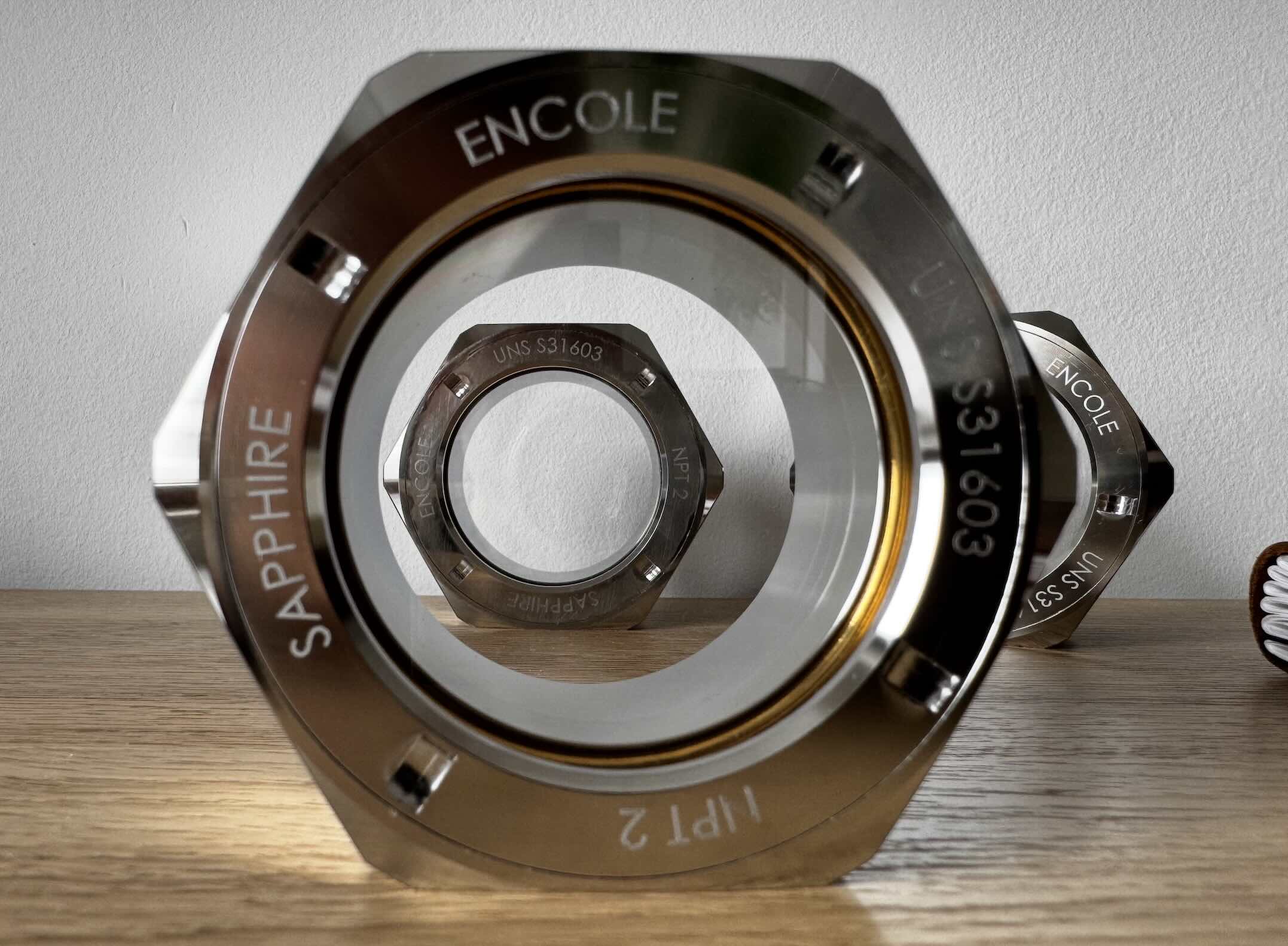
The assembly consists of a 316L stainless steel body, a C-axis Kyropoulos-grown sapphire window, an Alloy 718 (Inconel) gold-plated metal C-seal, and a 316L stainless steel cover on the non-process side.
The C-seal sits directly between the main housing and the sapphire on the process side. This arrangement separates the compressive force of the seal from the axial force of process pressure acting on the opposite face of the window, reducing stress concentrations at the sealing surfaces. Product example: High-Pressure High-Temperature (HPHT) Sight Glass NPT 1/2.
The window is clamped with a controlled gap, allowing it to float and distribute load evenly. Thermal expansion in the axial direction is partially accommodated by sapphire's natural expansion along the C-axis, supplemented by springback within the C-seal's yield range.
Because the C-seal faces the process fluid directly, elevated pressure increases contact force at the sealing surfaces: a self energizing effect that improves seal integrity under load.
The design is fully sanitary: all wetted surfaces are open to purging, with no crevices that could trap particles or bacteria. This makes it suitable for hygienic and semiconductor applications where virtual leaks, trapped gas volumes that outgas slowly are not acceptable. For corrosive process environments, the body material can be specified in Hastelloy.
The product has undergone extensive testing across multiple protocols. Encole is in the final stages of releasing this sight glass line as standard catalog products.